

LPG Cylinder Welding Machine
Wuxi Qineng Welding System Co., Ltd.: Your Professional LPG Cylinder Welding Machine Manufacturer!
Wuxi Qineng Welding System Co., Ltd. is a high-tech enterprise with R&D capability, which possesses dozens of domestic patents (with the visual laser dual-tracking welding system as the core). Qineng has been engaged in welding technology research for more than 50 years. We have a team of experienced technical personnel, which equipped ourselves with sufficient technical power to provide our customers with high quality and reasonable price products.
Powerful R&D Capabilities
Our company stands as a core competitive advantage. Continuous technological innovation and product upgrades enable the company to consistently deliver high-performance welding equipment that meets market demands. These machines are highly regarded both domestically and internationally, finding their way into global markets like the USA, Turkey, and Brazil, earning widespread acclaim from customers.
Comprehensive Product Portfolio
Our company specializes in producing a complete range of automated welding equipment for various applications, including TIG, MAG, MIG, PAW, and related ancillary equipment. This extensive product lineup ensures the company can address the diverse needs of clients across different industries, efficiently and effectively meeting production requirements from LPG cylinders to pressure vessels.
Dedicated to Smart Manufacturing
In the push towards smart manufacturing, we are committed to fulfilling sophisticated customer demands by driving the transformation towards intelligent production processes. The company's technical team continually explores how to leverage cutting-edge automation technology and smart control systems to enhance production efficiency, reduce labor costs, and ensure product quality consistency and reliability.
Open Communication and Collaboration
We place great emphasis on communication and collaboration with clients. The company welcomes visitors from around the globe to its factory to witness its production capabilities and technological prowess. Furthermore, Qi Neng is eager to send its technical teams to customer sites to gain a deep understanding of their needs and offer tailored solutions. This open and dedicated approach enables Qi Neng to serve its clients better, fostering long-term, stable partnerships.
-
![LPG Cylinder Longitudinal Welding Machine]() LPG Cylinder Longitudinal Welding MachineLPG Cylinder Longitudinal Welding Machine is designed to provide Longitudinal Welding for parts that are bent in the forms of cylindrical, conical and rectangular as well as sheet metals in the...read more
LPG Cylinder Longitudinal Welding MachineLPG Cylinder Longitudinal Welding Machine is designed to provide Longitudinal Welding for parts that are bent in the forms of cylindrical, conical and rectangular as well as sheet metals in the...read more -
![LPG Cylinder Circumferential Welding Machine]() LPG Cylinder Circumferential Welding MachineLPG Cylinder Circumferential Welding Machine is an automated equipment specially used for automatic welding of girth welds of liquefied petroleum gas (LPG) cylinders. The fabrication of tubes or...read more
LPG Cylinder Circumferential Welding MachineLPG Cylinder Circumferential Welding Machine is an automated equipment specially used for automatic welding of girth welds of liquefied petroleum gas (LPG) cylinders. The fabrication of tubes or...read more -
![LPG Cylinder Circumferential Welding Machine]() LPG Cylinder Circumferential Welding MachineThis LPG cylinder circumferential welding machine line consists of frame, Panasonic welding power supply GS6-500 (customized), welding seam visual laser dual tracking system, circulating cooling...read more
LPG Cylinder Circumferential Welding MachineThis LPG cylinder circumferential welding machine line consists of frame, Panasonic welding power supply GS6-500 (customized), welding seam visual laser dual tracking system, circulating cooling...read more -
![LPG Cylinder Double Head Circumferential Welding Machine]() LPG Cylinder Double Head Circumferential Welding MachineThis LPG cylinder double-head circumferential welding machine is mainly composed of the following parts: machine base, visual laser dual tracking system, electrical cabinet, welding power supply,...read more
LPG Cylinder Double Head Circumferential Welding MachineThis LPG cylinder double-head circumferential welding machine is mainly composed of the following parts: machine base, visual laser dual tracking system, electrical cabinet, welding power supply,...read more -
![LPG Cylinder Longitudinal Welding Machine]() LPG Cylinder Longitudinal Welding MachineThis LPG cylinder longitudinal welding machine consists of the following parts: machine base, welding power source YD-500GL, water chiller, crossbeam, guide rail, supporting plate, welding gun and...read more
LPG Cylinder Longitudinal Welding MachineThis LPG cylinder longitudinal welding machine consists of the following parts: machine base, welding power source YD-500GL, water chiller, crossbeam, guide rail, supporting plate, welding gun and...read more -
![LPG Cylinder Intelligent Welding Line]() LPG Cylinder Intelligent Welding Line1 set of three-station trimming, joggling and polishing machine(for cylinder lower shell); 1 set of three-station foot ring welding machine; 1 set of three-station trimming and polishing...read more
LPG Cylinder Intelligent Welding Line1 set of three-station trimming, joggling and polishing machine(for cylinder lower shell); 1 set of three-station foot ring welding machine; 1 set of three-station trimming and polishing...read more -
![LPG Cylinder Collar Ring Welding Machine]() LPG Cylinder Collar Ring Welding MachineThis LPG cylinder collar ring automatic machine adopts a vertical structure, consisting of welding power supply, control box, welding gun mechanism, collar ring fixture, pneumatic mechanism,...read more
LPG Cylinder Collar Ring Welding MachineThis LPG cylinder collar ring automatic machine adopts a vertical structure, consisting of welding power supply, control box, welding gun mechanism, collar ring fixture, pneumatic mechanism,...read more -
![LPG Cylinder Foot Ring Welding Machine]() LPG Cylinder Foot Ring Welding MachineThis LPG cylinder foot ring automatic welding machine adopts a horizontal structure, and consists of welding power supply, control box, welding gun mechanism, foot ring clamp, cylinder body clamp,...read more
LPG Cylinder Foot Ring Welding MachineThis LPG cylinder foot ring automatic welding machine adopts a horizontal structure, and consists of welding power supply, control box, welding gun mechanism, foot ring clamp, cylinder body clamp,...read more -
![LPG Cylinder Valve Seat Welding Machine]() LPG Cylinder Valve Seat Welding MachineThis LPG cylinder valve seat automatic welding machine adopts a vertical structure, consisting of welding power supply, control box, welding gun mechanism, valve seat fixture, pneumatic mechanism,...read more
LPG Cylinder Valve Seat Welding MachineThis LPG cylinder valve seat automatic welding machine adopts a vertical structure, consisting of welding power supply, control box, welding gun mechanism, valve seat fixture, pneumatic mechanism,...read more -
![LPG Cylinder Spot Welding Machine]() LPG Cylinder Spot Welding MachineThis LPG cylinder spot welding machine is used for the pressure assembly of the upper and lower shells. Vertical structure, the rotating platform on which the workpiece is placed is driven and...read more
LPG Cylinder Spot Welding MachineThis LPG cylinder spot welding machine is used for the pressure assembly of the upper and lower shells. Vertical structure, the rotating platform on which the workpiece is placed is driven and...read more
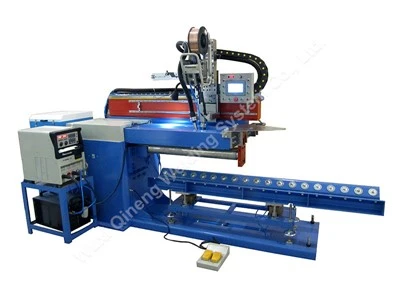


The equipment is specially designed for welding gas cylinders after connecting. Equipment automation degree is high, the staff will be a combination of products on the equipment manipulator, and automatic feeding。 automatic welding, automatic feeding, and automatic manipulator automatically return to the original position. The equipment is simple to operate and durable. The LPG Cylinder Body Welding machine is a submerged arc welding (SAW) machine composed of a welding automat and welding power pack. The welding automat holds the upper and lower cylinder halves horizontally and rotates them for the fixed welding head to weld.
Advantages of LPG Cylinder Welding Machine
Precise Welding Control
The Liquefied Petroleum Gas (LPG) cylinder welding machine offers unparalleled precision in welding control. This level of accuracy is crucial as it ensures consistently high-quality welds. These machines typically incorporate advanced technologies that monitor welding parameters such as current, voltage, and welding speed, ensuring each weld meets the same quality standards. Industry studies show that using efficient automatic welding equipment, like the LPG cylinder welding machine, can reduce welding defect rates by up to 50%.
Enhanced Production Efficiency
Using a specialized LPG cylinder welding machine significantly boosts production line efficiency. The automated process not only increases production speed but also reduces the likelihood of human error. Data comparison between manual welding and automatic welding machines shows that the latter can increase production efficiency by more than threefold. This means that within the same working hours, more products can be produced, offering a significant competitive advantage for businesses.
Simplified Operation
The operation of automatic welding machines is typically designed to be more user-friendly, simplifying the operational process and reducing the skill requirements for operators. Modern LPG cylinder welding machines are equipped with intuitive interfaces and programmable operational procedures, allowing operators to be trained and start working with minimal training, greatly reducing product defects caused by operational errors.
Enhanced Safety
When handling flammable and explosive LPG cylinders, safety is of paramount importance. Professional welding machines feature stringent safety measures, such as emergency stop buttons, automatic cooling systems, and built-in safety check programs, significantly reducing operational risks. Statistics show that the accident rate of automated welding equipment is nearly 70% lower than that of traditional manual welding.
Energy Saving and Environmental Protection
Modern LPG cylinder welding machines are designed with energy efficiency and environmental protection in mind. Through optimized energy management systems, such as activating the welding electrode only when needed, energy consumption can be significantly reduced. Additionally, minimizing waste and harmful emissions during the welding process helps enterprises achieve green production and sustainable development goals.
Safety Requirements for LPG Cylinder Welding Machine


Cylinder Shell Assembly
LPG cylinders are typically made from steel or other high-strength materials. The cylinder shell is one of the key components, and the welding machine is used to join the longitudinal seam of the shell, forming a cylindrical structure.
Welding Methods
LPG cylinder welding machines utilize various welding methods, such as submerged arc welding (SAW), gas metal arc welding (GMAW), or resistance seam welding. The choice of welding method depends on the cylinder material, thickness, and manufacturing requirements.
Welding Automation
These machines are often automated to ensure consistent and high-quality welds. They may include features like automatic seam tracking, torch positioning, and welding parameter control. Automation helps minimize human error and improves welding efficiency.
Safety Features
Safety is paramount when working with LPG cylinders. Welding machines designed for LPG cylinder manufacturing typically incorporate safety features such as gas monitoring systems, fire prevention measures, and emergency shutdown mechanisms to mitigate the risks associated with gas leaks or fire hazards.
Quality Control
Quality control is essential in LPG cylinder production. Welding machines may be equipped with inspection systems, including visual inspection, X-ray, or ultrasonic testing, to check for defects in the welds and ensure compliance with safety standards.
Cylinder Rotation and Fixturing
To ensure uniform welding and complete coverage of the seam, LPG cylinder welding machines often include fixtures or rotating mechanisms that allow the cylinder to be rotated during welding.
Operator Training
Skilled operators are required to operate LPG cylinder welding machines efficiently. Training and certification are essential to ensure that operators can safely and accurately use the equipment.
Compliance with Standards
LPG cylinder welding machines and the manufacturing process must adhere to various national and international standards and regulations, including those related to welding, pressure vessels, and safety.
Overview of Mainstream Welding Technologies and Their Applications
GMAW - Gas Metal Arc Welding (MIG)
One of the most popular types is Gas Metal Arc Welding or GMAW/MIG. This style of welding uses a shielding gas along a wire electrode, joining the two metals by heating them up. In order to properly perform this method, a constant voltage and direct-current power source are required.Typically, this is thought of as the most common industrial welding process. As one of the main types of welding, GMAW relies on four primary methods of metal transfer:
Globular Transfer creates a rougher weld bead due to the splattering and metal droplet size. This is ideal for welding thick metal plates.
Short-circuiting is the process of the welding wire making contact with the base metal in quick repeated taps. With little splattering, this is ideal for any welding position.
Spray Transfer transmits small droplets of molten metal in a consistent way to maintain steady contact. While it produces little splatter, it’s best done on horizontal pieces.
Pulsed spray is similar to spray transfer but relies on a high-low current pulse for micro-cooling periods. This can be used on a variety of metal plate thicknesses and many welding positions.Keep in mind, this type of welding is more complex than other alternatives, like SMAW. Additionally, it can be very sensitive to breezes that can disrupt the shielding gas enough to compromise a welding job.
SMAW - Shielded Metal Arc Welding (Stick Welding)
Another popular option among the welding process types is Stick or SMAW. Stick Welding relies on a current flowing through an electrode rod to the parent material to weld two metals together. Of all the types of welding machines and processes, a stick is considered one of the easier ones to learn and requires the least experience to master. Even on rusty materials, a strong weld can be created with a stick welder. For this reason, this type of welding is well-equipped for outdoor use, especially since it doesn’t require a shielding gas to do it. Typically, stick welding is used for thicker metals. But it does come with some considerations. Stick welding can only be used with particular metals, and it does cause quite a bit of splatter. In addition, it can produce heavy smoke that requires proper ventilation. Cons aside, stick welding is a simple and accessible solution, making it wonderful for everyday maintenance and welding needs.
FCAW - Flux Cored Arc Welding
When it comes to welding major types, Flux Cored Arc Welding is the go-to alternative to shield welding. Praised for its high welding speed and portability, this style of welding is commonly used in construction projects and can be used in a number of different welding projects.When navigating what types of welders there are, this is likely one of the most flexible options. Since FCAW offers many different operating angles, polarity options, voltage levels, and speeds of the wire feed, it can be relied upon for many applications. Additionally, with a faster welding speed, the newly joined metals will cool faster than other alternatives.Keep in mind, if a welding technician is using a flux-cored wire, it’s important to look for porosity in the welded joint to ensure a strong weld. In addition, due to the smoke and fumes, this is best used outdoors or in a well-ventilated space.
GTAW - Gas Tungsten Arc Welding (TIG)
When exploring “what are the 4 types of welding,” Gas Tungsten Arc Welding, or TIG, is one of the top 4 types. This type of welding allows for high precision and aesthetic welds that stand out from the rest.While GTAW offers increased precision and style, it does have some considerations. Most notably, TIG welding is harder to learn and involves a slower process. With this in mind, it is best used to weld hydraulic cylinder structures that are thin and made of stainless steel, magnesium, or copper.The GTAW/TIG machine shoots a consumable tungsten electrode with a variable current, all controlled with a foot pedal. Unlike other types of welding, which use a continuous wire feed, the technician will hold a consumable filler rod in one hand, while the torch works in the other. This means you control the feed with the torch gun while bracing with the other for a feed entirely in your control.With this type of welding, you have much more control of the amount of current, and additionally, control the heat with a foot pedal. As a result of this heightened control. You can create a more durable, high-quality weld that’s built to last.
Certificate

Frequently Asked Questions
As one of the most professional LPG cylinder welding machine manufacturers and suppliers in China, we're featured by quality products and good price. Please rest assured to buy high-grade LPG cylinder welding machine from our factory.
LPG Cylinder Automatic Welding Machine, Circumferential seam welding machine, Linear Welding Machine