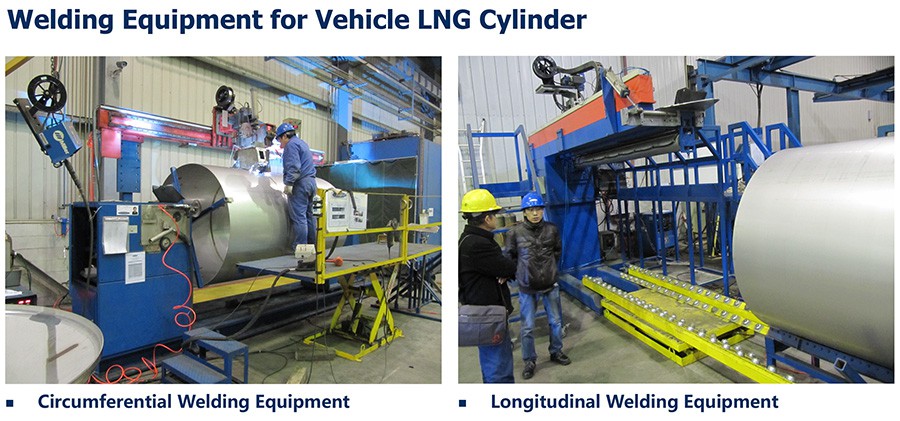

1. Focus on Manufacturing Precision and Stability
LNG cylinders require extremely high standards for sealing and structural strength, and manufacturing precision directly determines the product pass rate. It's crucial to consider the equipment's ability to control processing errors, the maturity of the core components' materials and processing technology, and whether it can maintain stable performance during long-term continuous operation. Evaluate the equipment's servo control system and positioning system accuracy parameters, as well as feedback from previous users, to understand if there are issues such as precision drift or frequent malfunctions during mass production, avoiding product defects or production interruptions due to equipment instability.
2. Match Production Capacity and Flexibility
Determine the equipment capacity based on your production scale, avoiding resource waste due to overcapacity or insufficient capacity to meet order demands. At the same time, consider the diverse market demands for LNG cylinder specifications and models. The equipment should have a certain degree of flexibility, allowing for quick switching of production parameters for different products and adapting to the manufacturing of multi-specification cylinders. Pay attention to the modular design of the equipment, whether it supports subsequent capacity upgrades or functional expansion, reserving space for future business development and enhancing the long-term value of the equipment.
3. Consider Technological Advancement and Compliance
Prioritize manufacturing equipment that utilizes advanced technology. Advanced technology not only improves production efficiency but also optimizes product quality and reduces energy consumption and labor costs. Verify that the equipment complies with relevant national and industry standards, meeting safety and environmental regulations for LNG cylinder manufacturing, avoiding production limitations due to non-compliant equipment. Furthermore, consider the technology's update and iteration capabilities, whether the equipment supplier has continuous R&D capabilities, and whether they can provide subsequent technical upgrade services to ensure that the equipment technology does not lag behind market development.

4. Evaluate Supplier Service and After-Sales Support
The overall strength and service level of the supplier directly affect the equipment's user experience. Evaluate the supplier's industry reputation, production experience, and R&D capabilities, and understand whether they have comprehensive pre-sales consulting, installation and commissioning services, and after-sales maintenance and spare parts supply systems. High-quality after-sales support can quickly resolve problems that arise during equipment operation, reducing downtime and production losses. You can comprehensively evaluate the supplier's service quality and performance capabilities by referring to industry case studies and conducting on-site inspections of the supplier's production base to ensure the reliability of the cooperation.
If you would like to learn more about the factors involved in choosing an LNG Cylinder Manufacturing Machine or LNG Cylinder Longitudinal Welding Machine, please contact Wuxi Qineng Welding System. Our team is happy to assist you.