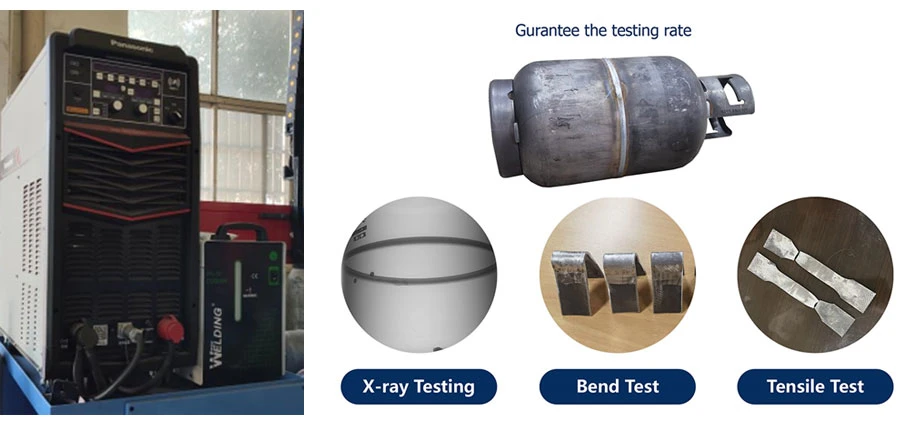

From what aspects can the performance of LPG cylinder collar ring automatic machine be judged?
Welding quality related performance
Weld quality:
Strength: Weld strength is a key performance indicator. A high-quality LPG cylinder welding machine should be able to make the weld strength similar to or higher than the parent material, ensuring that the weld will not break when the cylinder is subjected to LPG pressure. This can be evaluated by performing mechanical property tests such as tensile and bending tests on the welded samples.
Sealing: Since LPG is a flammable and explosive gas, the sealing of the weld is very important. A good welding machine should be able to ensure that the weld is free of defects such as pores, cracks and slag inclusions to prevent gas leakage. Non-destructive testing methods such as ultrasonic testing, magnetic particle testing, and penetrant testing can be used to check the defects inside and on the surface of the weld.
Appearance quality: The weld should be flat, smooth, and uniform in width. This not only affects the appearance of the cylinder, but also reflects the welding quality to a certain extent. Observe whether the weld has undercut (a depression formed by the melting of the parent material at the edge of the weld), weld nodules (metal accumulation in the weld), and other appearance defects.
Welding stability:
During the welding process, the welding machine should be able to maintain stable welding parameters. For example, the fluctuation range of parameters such as welding current, voltage and welding speed should be small to ensure the consistency of weld quality. For example, in long-term continuous welding operations, the current fluctuation range should be controlled within ±5% of the set value to ensure the stability of weld penetration and quality.
Work efficiency related performance
Welding speed:
The welding speeds of different welding machines vary greatly. For LPG cylinder welding, fast welding speed can improve production efficiency. Under the premise of ensuring the quality of the weld, the equipment that can complete the welding task quickly has better performance. For example, for a cylinder of a certain specification, some welding machines may take 30 minutes to complete the welding, while a high-performance welding machine may only take 20 minutes.
The speed adaptability of the welding machine under different welding tasks and materials should also be considered. Equipment that can flexibly adjust the welding speed according to factors such as the material, thickness and structure of the cylinder is more advantageous.
Automation and ease of operation:
Welding machines with a high degree of automation can reduce manual operations and improve efficiency. Functions such as automatic feeding, automatic path planning, and automatic parameter adjustment can save time and manpower. For example, a welding machine with an automatic feeding system can automatically feed welding wire according to the welding progress, avoiding frequent manual additions and improving welding continuity.
The operation interface should be concise and clear, making it easy for operators to set welding parameters, start and stop the welding process, etc. An operation method that is easy to learn and use can reduce operator training time and improve work efficiency.