

Key points for application of LPG Cylinder Spot Welding Machine
The application of LPG cylinder spot welding machine in the automated production line needs to take into account equipment linkage, process adaptation and safety redundancy, and improve production efficiency through modular design. The specific points are as follows:
1. Production line integration and positioning accuracy
Multi-station linkage: Linked with the conveyor line (speed 0.5-1m/min) and the cylinder positioning tooling (repeat positioning accuracy ±0.5mm), the servo motor drives the three-axis mechanical arm (X/Y/Z axis travel ≥500mm) to achieve automatic welding of circumferential seams/longitudinal seams. For example, at the cylinder valve seat welding station, the cylinder reference point is identified by the visual sensor (resolution 1280×1024), and the positioning error is automatically compensated to ensure that the angle deviation between the welding point and the axis of the bottle body is ≤1°.
Quick-change tooling design: For cylinders of different specifications (such as 5kg/15kg/50kg), a standardized fixture interface (positioning pin tolerance ±0.02mm) is adopted, and welding parameters (such as current and pressure) are switched through the PLC program. The changeover time is controlled within 10 minutes to meet the production needs of multiple varieties and mixed lines.
2. Process Automation Control
Parameter adaptive adjustment: Built-in welding expert system, automatically matching current (60-100kA), welding time (15-30 cycles) and electrode pressure (0.4-0.6MPa) according to the cylinder wall thickness (2-4mm). For example, when welding 2mm galvanized cylinders, the system automatically starts the "pulse current + slow rise and slow fall" mode to reduce the spatter caused by zinc layer evaporation, and maintains pressure stability through the electrode wear compensation algorithm (automatically compensates 0.1mm stroke every 1000 welding times).
Online quality monitoring: An integrated ultrasonic flaw detector (frequency 5-10MHz) and a tension sensor (range 0-5000N) are used to detect internal defects in the weld nugget (such as pores and lack of fusion) and the tensile shear force of the weld. The data is uploaded to the MES system in real time. When the data exceeds the standard, defective products are automatically marked and the production line is shut down.
3. Safety and maintenance design
Explosion-proof linkage mechanism: interlocked with the workshop combustible gas alarm system (detection range 0-100% LEL). When the LPG concentration exceeds 10% LEL, the welder automatically cuts off the high-voltage power supply and starts the ventilation device (air volume ≥ 5 times/h). The electrode cooling system (water temperature 30±5℃) is equipped with a flow switch. When there is a lack of water, welding will be stopped immediately to prevent the electrode from overheating and igniting the leaked gas.
** Predictive maintenance**: Vibration sensors (sampling frequency 10kHz) are used to monitor the status of key components such as transformers and motors, set vibration thresholds (such as alarms when acceleration ≥ 5m/s²), and generate maintenance plans based on the number of welding times (it is recommended to replace the electrode head every 5,000 times), reducing unplanned downtime to ≤1%.
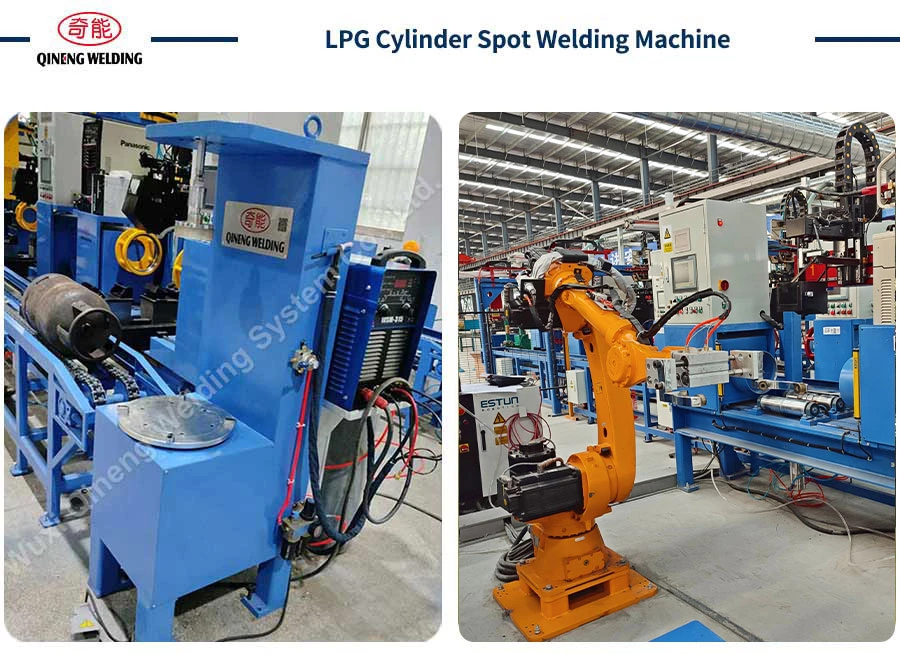
Efficiency improvement case: An automated production line uses a 6-axis spot welding robot with a visual positioning system. The cycle time of a single device is shortened from 20 seconds per piece for manual welding to 8 seconds per piece, and the defective solder joint rate is less than 0.3%, meeting the large-scale production demand of 500,000 steel cylinders per year.
If you want to know the application points of LPG Cylinder Spot Welding Machine in automated production lines, you are welcome to visit www.qinengwelding.com !