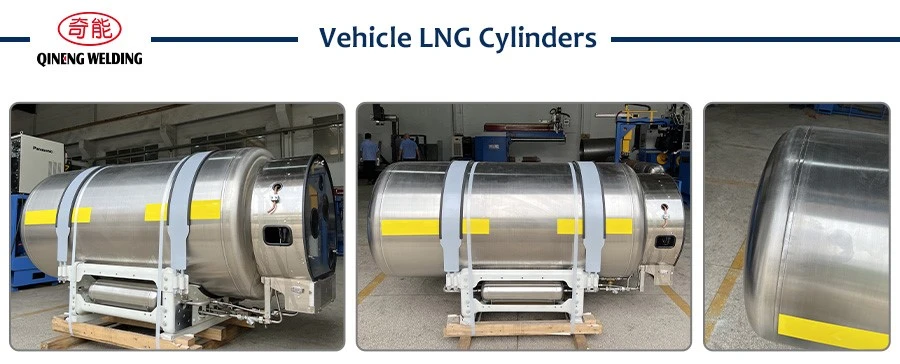

Suggestions for improving the design of Vehicle LNG cylinders
The key technical indicator of vehicle LNG cylinders is the cold preservation performance (i.e., evaporation rate), and the key to cold preservation performance is to reduce the conduction, transmission, and radiation of cold energy losses.
The key to conduction cooling loss lies in design, which is to make the distance of conduction cooling as long as possible. The smaller the conduction surface, the smaller the cooling loss. It is also important to use materials with low thermal conductivity coefficients. For example, the thermal conductivity coefficient of fiberglass is lower than that of stainless steel, while the thermal conductivity coefficient of stainless steel is lower than that of carbon steel.
The radiation cooling loss is reduced by using anti-radiation materials. The materials currently used are aluminizing film and aluminum foil, and aluminum foil has a better effect. Usually, 24 layers of aluminum foil can make the radiation cooling loss almost zero. In order to prevent the aluminum foils from contacting each other, glass fiber is used to separate them.
The loss of cold energy due to the intermolecular collision transfers heat from the outside to the inside. The use of vacuum can reduce the loss of cold energy. Generally speaking, when the vacuum degree is higher than 2×10⁻²Pa, the use requirements can be met. When the vacuum degree is lower than 1×10⁻¹Pa, the performance will be affected. Therefore, the vacuum degree must be kept higher than 2×10⁻²Pa for a long time. The key is to analyze the gas absorbed by the material to avoid affecting the vacuum degree due to the slow analysis of the gas during long-term use.
The amount of gas absorbed by each material is different. Among the materials used in our LNG cylinders, glass fiber has the largest absorption capacity, followed by stainless steel and aluminum foil. Although there are many ways to parse out the gas, increasing the temperature is the simplest and most practical. According to the data, when the temperature increases by 10%, the amount of gas parsed will increase 10 times. Therefore, during the vacuuming process, the temperature inside the tank should be increased as much as possible to increase the amount of gas parsed by the material, so as to reduce the precipitation of gas during use and ensure the quality of the product. In order to improve the efficiency of vacuuming, the temperature and diameter of the inlet gas should be increased as much as possible. The more gas parsed, the better the long-term vacuum maintenance of the product.
QINENG WELDING mainly produces complete sets of automated welding equipment (TIG welding, MAG welding, MIG welding, PAW welding) for various purposes, as well as related supporting equipment. Our welding equipment is used to produce LPG cylinders, LNG cylinders, fire extinguisher, refrigerant cylinders, water heater, dewar tanks, pressure vessels, etc...We have much experience in providing customers with a complete production line of LNG vehicle cylinders.